The First Clue: Why 9 Is Different
Reset the frame. Discover why nine behaves like a container and not just a number.
Training Program - Companion to the Book
The Full Formula Training turns the book into a guided practice: a paced journey through number, geometry, time, and the daily rituals that keep your compass true.
The Signal
This training is built to be tested. We move from clue to proof, from theory to lived rhythm, so the pattern becomes something you can feel and apply.
Curriculum
Each module includes a short lecture, a guided worksheet, and a practice session that anchors the lesson in your day.
Reset the frame. Discover why nine behaves like a container and not just a number.
Learn to compress large numbers to their single-digit signature and trace the pattern.
Map the pattern to form, structure, and the geometry beneath everyday objects.
Why right angles set the stage for everything from architecture to measurement.
Use the slope formula as a map for movement, intention, and direction.
Reframe gravity as a pressure field and explore how that changes your perception.
Understand the urgency of the moment and how to stay aligned as the pace increases.
Lock in a daily ritual that keeps the system alive in your schedule.
Use sound and attention to create a simple, repeatable water ritual.
Module Library
Progress saves on this device. Take one panel at a time and check off steps as you go.
Overall progress
Module 01
9 is the last single digit. Every number after it is a remix of the same digits, which makes 9 a reset point.
Digits 1 through 9 are like the alphabet of numbers. After 9, you are not making new digits, you are combining the same ones again (10 is 1 and 0, 12 is 1 and 2, 108 is 1, 0, and 8).
That makes 9 the edge of the single-digit world. It is the place where the loop turns back on itself.
Even without 9, the answer returns to 9. That is the first clue.
If numbers keep looping back to 9, you can use 9 as a lens to read patterns in time, measurements, and your daily rhythm.
The goal is not speed. The goal is to see the loop clearly and calmly.
Module 02
Digital root is a simple shortcut: add digits until one digit remains, then you have the number's "signature."
Digital root means: add the digits of a number. If the result is still more than one digit, add again. Stop when you reach one digit.
This one digit is the number's quick signature. It lets you compare huge numbers and small numbers the same way without getting lost in the size.
There is no trick here. If the sum is 10 or more, just add again. If the sum is 9 or less, you are done.
Try 2026 next: 2+0+2+6 = 10, then 1+0 = 1.
Digital root gives you a fast way to compare any numbers, big or small. It helps you see repeating rhythms instead of getting lost in large numbers.
You will use this for the Day Finder and for the 3-6-9 cadence later.
Module 03
The same pattern shows up in shapes. We look at angle totals and reduce them to one digit.
Geometry is the math of shapes. Here we only use totals, then reduce them with digital root. No advanced formulas needed.
Every basic shape has a known total for its interior angles. You do not have to measure anything. We simply take the total and reduce it to one digit.
This shows whether the same signature appears across different shapes. If it does, the pattern is not just in numbers, it is in structure.
The same reduction works for squares and 3D shapes.
Module 04
Right angles are the corners of our world. 90 reduces to 9, and a full square reduces to 9 too.
A right angle is a clean corner. Walls, screens, books, and tables are built on right angles because they are stable.
A right angle is exactly 90 degrees. That is why it shows up everywhere we need balance or straight edges. It is the simplest way to build something that does not wobble.
When you reduce 90, you get 9. When you add four right angles to make a square, you get 360, and that reduces to 9 too. The corner and the whole shape share the same signature.
The corner and the whole shape both return to 9.
When the same number appears in the corner and the whole shape, the pattern starts to show up in everyday life.
This bridges numbers to things you can touch.
Module 05
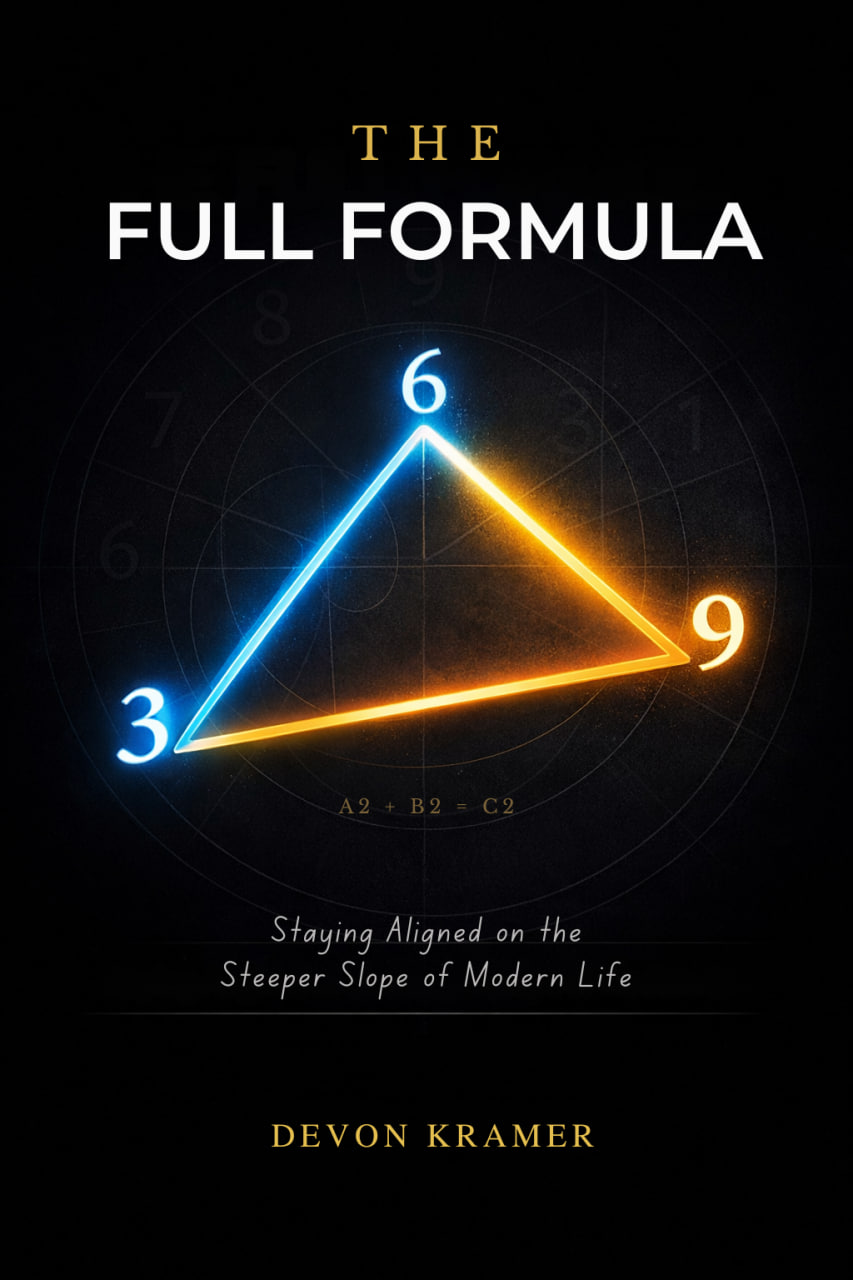
The slope formula connects the sides of a right triangle so you can measure distance and direction.
In a right triangle, the two short sides (a and b) always relate to the long side (c). That relationship lets you find missing distances.
Think of a ladder leaning on a wall. The floor and the wall make a right angle, and the ladder is the long side. The slope formula tells you the ladder length if you know the height and the distance from the wall.
This is not about memorizing. It is about using a simple relationship to measure real space.
The formula keeps the triangle honest.
You can estimate the diagonal of a room, the height of a ladder, or the distance across a screen. Geometry becomes useful.
In this training, slope also means steady progress in one direction.
Module 06
Explore a different picture of gravity: pressure that pushes rather than a force that pulls.
Instead of only picturing gravity as a pull, imagine pressure from all sides, like being in a gentle ocean of air.
This is a model to explore, not a rule you must accept. The purpose is to help you feel the idea in your body. Pressure can be felt, and that makes the concept easier to understand.
Think of a balloon in water. The water presses from all sides. This module asks you to imagine air doing something similar, helping explain why things feel grounded.
This is one way to picture weight and grounding.
A new model can unlock new questions. It can also change how your body feels in space, which is part of alignment.
This module is about curiosity, not debate.
Module 07
A steeper slope means a faster pace. Alignment keeps you steady when life accelerates.
When the slope gets steeper, you need a steady rhythm, not more speed. Alignment keeps you upright.
A steeper slope means you can lose balance faster. The answer is not to sprint. The answer is to choose a simple rhythm and stick to it.
The 3-6-9 cycle gives you a rhythm you can return to, even when life feels fast or noisy.
The training provides that rhythm.
When life speeds up, people lose their center. Rhythm and alignment keep your decisions clear.
Alignment is the opposite of panic.
Module 08
A practice is a small daily loop you repeat. Small and consistent beats big and perfect.
A practice is one small action you can keep doing. It is not a giant plan. It is a repeatable rhythm.
The smaller the practice, the easier it is to keep. The goal is not to do everything. The goal is to build trust with yourself through repetition.
Once the practice is steady, you can expand it. But stability comes first.
That is a complete practice loop.
Consistency builds trust with yourself. The practice is where learning becomes real in your body and schedule.
You do not need to do everything. You just need to do the loop.
Module 09
A simple ritual: place water near sound and focus your attention for 3 to 9 minutes.
Water charging is a focused practice where you place a glass, plastic, or copper container of water near a speaker or phone, play a steady frequency, and hold a clear intention.
Some people believe water can hold patterns or "memory," and that sound can help imprint a frequency. This idea was popularized by Dr. Masaru Emoto, but the science is debated. Treat this as a personal ritual and notice how it affects your focus and mood.
The point is consistency: same water, same time, same frequency, and clear attention.
When the timer ends, pause for 10 seconds, then drink the water.
Choose one frequency per session. Keep it simple.
Module Quiz
These are quick checks, not a test. Answer slowly and use the modules if you need a refresher.
Score: 0 / 18
Choose the best answer. If you miss one, read the module and try again.
Choose an answer.
Choose an answer.
Choose an answer.
Choose an answer.
Choose an answer.
Choose an answer.
Choose an answer.
Choose an answer.
Choose an answer.
Choose an answer.
Choose an answer.
Choose an answer.
Choose an answer.
Choose an answer.
Choose an answer.
Choose an answer.
Choose an answer.
Choose an answer.
Deep Reflection
Write one honest paragraph. Slow is good. This is where the learning becomes real.
In your own words, describe what the slope means to you. How do the 3-6-9 pattern and the 36-day cycle help you stay aligned when life accelerates? Explain it as if you were teaching someone new, and include one example from your own life.
Training Format
Each lesson is designed to be completed in 30 minutes and revisited across a 9-day rhythm.
Worksheets translate the numbers into personal decisions, projects, and plans.
Daily alignment rituals keep the slope steady as the week accelerates.
Practice Cycles
Each cadence is a container. Short cycles build momentum, longer cycles build identity. Choose the one that fits your season.
Start small. Learn the basics and build confidence in nine days.
Two 18-day loops that turn a new pattern into a stable habit.
Twelve 36-day cycles that build deep, long-term alignment.
Find Your Day
Add the digits of the month, day, and year, then reduce to one digit. Example: 1/17/2026 becomes 1+1+7+2+0+2+6 = 19, then 1+9 = 1.
A gentle on-ramp. One small lesson and one small action each day.
Nine days is short enough to finish and long enough to feel a real shift. It is the best way to build confidence.
If you only have 9 minutes, that is enough. Consistency matters more than speed.
The first 18 days break the old pattern. The next 18 days install the new one.
The 3-6-9 days repeat through the whole 36-day cycle (days 3, 6, 9, 12, 15, 18, 21, 24, 27, 30, 33, 36).
Two loops give your brain and body time to change. The first loop builds the pattern. The second loop makes it feel normal.
A long arc built from 12 cycles of 36 days. This cadence is for deep change that compounds.
A full alignment year gives you enough repetition to turn a practice into identity. You are no longer rushing, you are building a new baseline.
Congratulations!
If you completed the 9-day sprint, take a moment to review your notes and choose your next cadence.